
How Electrical Companies Can Remove Bottlenecks as Revenue Grows
Unlock Operational Freedom in Your Business
Revenue growth should create more room, not more pressure. For electrical companies, rising founder stress usually means the business has outgrown informal decision-making, unclear ownership, and founder-dependent workflows. Simple Operations helps you replace firefighting with a simple operating rhythm built on roles, rhythms, metrics, projects, and culture.
The short answer
When an electrical company grows but the founder feels more stressed, the real issue is usually operational complexity, not demand. The founder is still trapped in approvals, escalations, scheduling conflicts, and margin questions. Simple Operations reduces that pressure by clarifying roles, installing reliable rhythms, tracking the right numbers, and making delegation safe without sacrificing quality.
Reviewed by Gabe ArnoldUpdated
Why does electrical revenue growth make founder stress rise?
Growth raises stress when the founder is still the default decision-maker for every estimate question, scheduling conflict, customer escalation, and team exception. In electrical companies, more jobs often mean more moving parts, more handoffs, and more chances for confusion unless the operating model catches up.
What bottlenecks usually show up first in a growing electrical company?
The first signs are usually decision bottlenecks, inconsistent workflows, and daily interruptions that pull the founder away from strategic work. You may also see permit delays, job costing confusion, material shortages, and callbacks taking too long to resolve because no one knows who owns the next step.
How do roles and delegation reduce founder overload?
Clear roles reduce overload because people stop waiting for the founder to approve everything. In a growing electrical business, delegation works best when each role has visible responsibilities, clear decision rights, and simple expectations for technicians, dispatch, estimating, project management, and customer follow-up.
What rhythms help an electrical team stay aligned without constant interruptions?
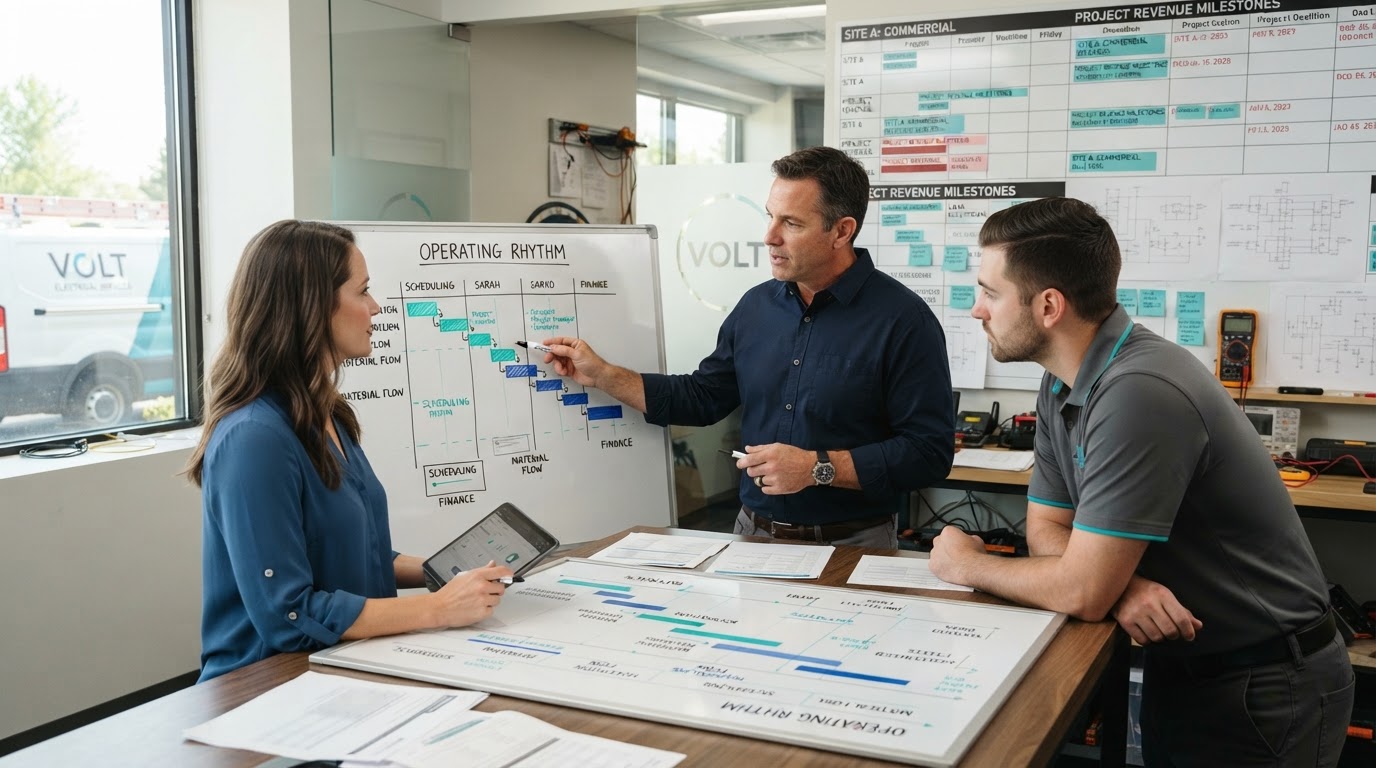
A predictable rhythm keeps the business from running on Slack, hallway questions, and emergency calls. Daily huddles, weekly planning, and targeted meetings help office and field teams know what matters, what changed, and where issues should surface before they become customer problems.
Which metrics matter most when founder stress is rising?
The most useful metrics are the ones that reveal operational health, not just activity. For electrical companies, that usually means looking at job progress, gross margin, backlog, callback rates, schedule reliability, cash flow, and whether projects are being completed without founder intervention.
How do projects and culture make delegation stick?
Delegation only sticks when projects have one owner and culture reinforces accountability. If the team treats every issue like it belongs to the founder, the bottleneck stays in place. When projects are visible and culture rewards ownership, the business can grow without depending on constant founder rescue.
Key takeaways
- Revenue growth can expose weak operations faster than it creates relief.
- Founder stress is often a capacity signal, not a personal failure.
- Electrical companies need clearer ownership as scheduling and job complexity increase.
- Delegation works best when decision rights are visible, not assumed.
- A steady operating rhythm reduces interruptions and firefighting.
- Projects stick when one person owns the outcome and culture supports accountability.
Putting it into practice
- Step 1
Name the bottleneck
Identify where work keeps routing back to the founder: approvals, dispatch, estimates, escalations, or job-cost questions. - Step 2
Clarify ownership
Assign one owner to each recurring process so the team knows who decides, who executes, and when to escalate. - Step 3
Install a simple cadence
Use a daily and weekly rhythm so issues are surfaced intentionally instead of interrupting the founder all day. - Step 4
Track a few meaningful metrics
Watch the numbers that show whether jobs, margin, and delivery are healthy before stress turns into a crisis. - Step 5
Make accountability normal
Tie projects and handoffs to visible ownership so the business becomes less dependent on founder memory and intervention.
Questions founders ask
Why does growth feel harder even when revenue is increasing?
Because revenue often increases complexity faster than systems can absorb it. In electrical companies, more work usually means more scheduling pressure, more coordination, and more decisions unless roles and rhythms are already in place.
Is founder stress a sign that something is wrong?
Not necessarily wrong, but it is a strong signal that capacity is tightening. Stress often shows that the founder is still carrying too many decisions and that the operating model needs to mature.
What happens if I hire more people before fixing operations?
Hiring without clarity usually creates more questions, not less. New people need role clarity, meeting rhythms, and simple handoffs or they will depend on the founder just like everyone else.
What is the simplest place to start?
Start with the biggest decision bottleneck. Usually that means clarifying who owns what, which issues get escalated, and when the team should make decisions without waiting for the founder.
How does Simple Operations help electrical companies specifically?
It gives the business a practical management layer built around roles, rhythms, metrics, projects, and culture. That helps electrical teams handle scheduling, escalations, and delivery more consistently while reducing founder dependence.