
How Plumbing Company Founders Can Delegate Decisions
Unlock Operational Freedom in Your Business
When a plumbing company grows faster than its operating structure, the founder often becomes the bottleneck. Revenue rises, but so does stress, because every decision, escalation, and exception still routes through one person. The fix is not more hustle. It is clearer roles, steadier rhythms, visible metrics, owned projects, and a culture that makes accountability normal.
The short answer
Plumbing founders get more stressed as revenue grows when growth outpaces delegation, decision rights, and repeatable systems. Simple Operations helps companies replace founder dependence with five operating principles: roles, rhythms, metrics, projects, and culture. That creates cleaner handoffs, fewer escalations, and more freedom for the founder to lead instead of firefight.
Reviewed by Gabe ArnoldUpdated
Why does plumbing revenue growth make stress rise?
Revenue growth often increases complexity faster than a plumbing company can absorb it. More calls, more dispatch decisions, more job changes, more customer escalations, and more hiring pressure all create more points where the founder gets pulled back in. The business is growing, but the operating model is still built around one overloaded decision-maker.
In plumbing, that pressure shows up quickly because the work is urgent and time-sensitive. Emergency jobs, parts issues, permit questions, and customer complaints cannot sit for long. If the founder is still approving too many choices, every interruption becomes expensive in time, margin, and attention.
What bottlenecks usually appear first in a plumbing company?
The first bottlenecks are usually decision bottlenecks, not demand problems. The founder gets asked to approve pricing exceptions, schedule changes, hiring choices, customer recoveries, and job scope decisions that should already have an owner. That creates constant context switching and keeps the business dependent on one brain.
You may also see workflow inconsistency. One dispatcher handles jobs a certain way, one technician communicates differently, and office follow-up varies depending on who is available. When that happens, quality depends too much on the founder’s direct involvement, and stress rises even if revenue looks healthy.
How do roles and delegation reduce founder overload?
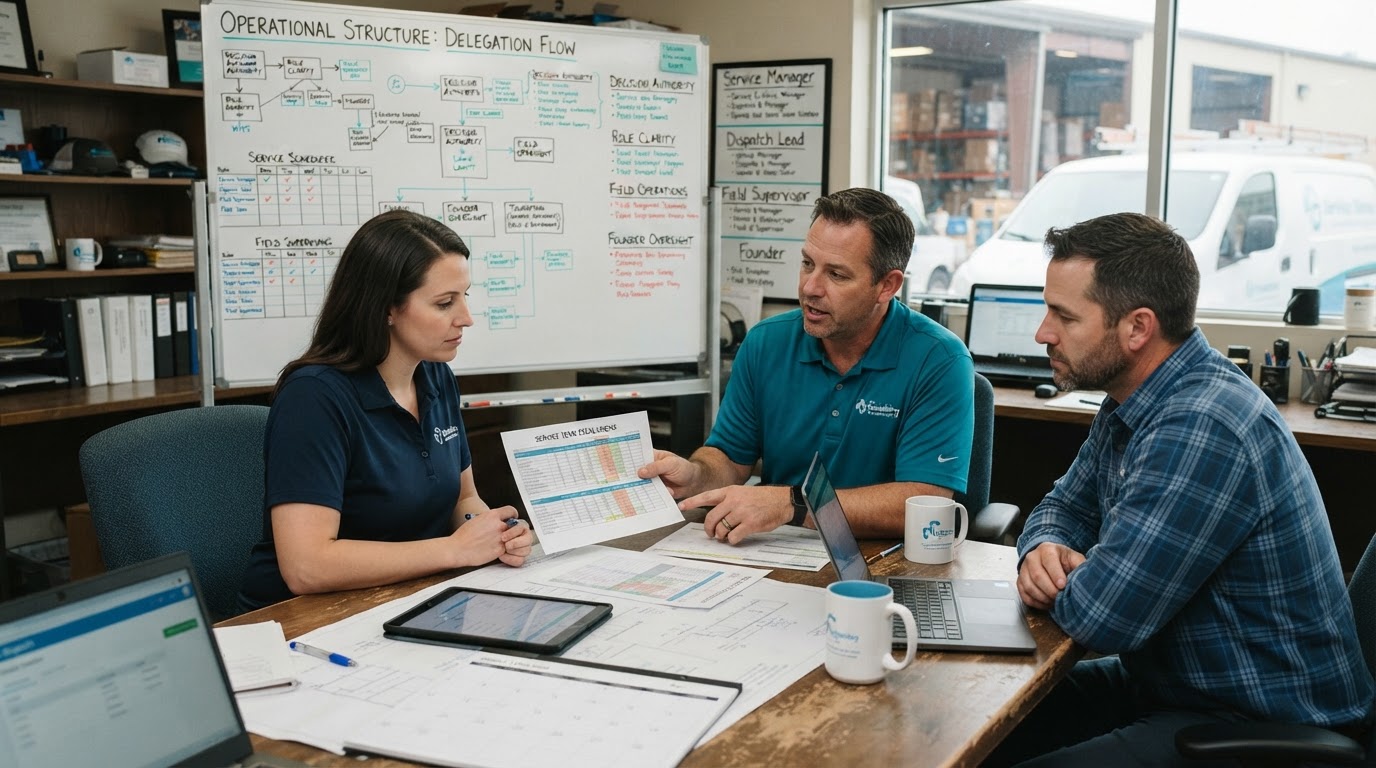
Roles and delegation reduce founder overload by removing the need for the founder to approve every next step. In a plumbing business, assign clear owners for dispatch, estimate follow-up, parts coordination, customer recovery, and job closeout. When responsibilities are visible and repeated questions have a set owner, work moves forward without constant founder intervention.
Delegation becomes safer when the team knows the boundaries of its authority. Simple Operations uses Four Levels of Delegation to help leaders decide how much decision-making to transfer and when. That protects quality while steadily moving the founder out of the middle of routine decisions.
What rhythms help plumbing teams stay calm and aligned?
Rhythm turns urgency into order. Instead of reacting to every call, a plumbing team needs predictable daily, weekly, and monthly touchpoints where issues are raised, decisions are made, and priorities are reset. That gives the founder fewer surprise interruptions and gives the team a reliable place to bring problems.
For dispatch-driven businesses, this matters even more because the day can change fast. A short daily huddle, a weekly planning rhythm, and a consistent review of open jobs can prevent small issues from becoming expensive fire drills. Meetings should be targeted and intentional, not loose conversations that create more confusion.
Which metrics matter when founder stress is rising?
The right metrics show where the business is slipping before the founder feels it in a crisis. For plumbing companies, that usually includes job closeout speed, conversion from lead to booked job, estimate follow-up, callback frequency, margin by job type, and technician utilization. These numbers help leaders see whether growth is healthy or simply busier.
Simple Operations teaches founders to track progress, not just activity. A company can have full calendars and still lose money or create chaos. Metrics give the founder a way to lead with facts instead of instinct alone, which lowers stress and improves decision-making.
How do projects and culture make delegation stick?
Projects and culture make delegation stick because they turn good intentions into shared behavior. A project should have one owner, a clear outcome, and visible next steps. If jobs, hiring, training, and service recovery are all treated as ownerless team efforts, they usually drift back to the founder.
Culture is what keeps the system alive after the first push. When accountability is normal, people bring recommendations instead of just problems. When clarity is kind, the team can handle more without guessing. That is how a plumbing company grows without turning the founder into the permanent emergency response plan.
Key takeaways
- Revenue growth can expose weak systems faster than it creates relief.
- When the founder is the default approver, the business becomes dependent on one person’s attention.
- Clear roles reduce repeat questions, handoff confusion, and decision bottlenecks.
- Delegation works best when authority levels are defined, not assumed.
- Plumbing teams need a predictable cadence because urgency never fully goes away.
- Metrics should reveal whether growth is healthy, not just whether the schedule is full.
Putting it into practice
- Step 1
Step 1: Map the founder bottlenecks
List the decisions, escalations, and approvals that still route through the founder every week. Group them by dispatch, estimating, customer recovery, hiring, parts, and job completion. - Step 2
Step 2: Assign one owner per process
Give each core workflow a single owner so the founder is no longer the fallback for every issue. Make the ownership visible to the whole team. - Step 3
Step 3: Install a simple meeting rhythm
Create a short daily and weekly cadence for open jobs, blockers, and priorities. Keep it targeted so the business gains clarity instead of another layer of admin. - Step 4
Step 4: Track a few meaningful metrics
Choose numbers that show demand quality, delivery quality, and margin health. Review them consistently so problems are visible before they become urgent. - Step 5
Step 5: Strengthen accountability culture
Set expectations clearly, review outcomes regularly, and reward ownership. The goal is a team that solves more without waiting for the founder to weigh in.
Questions founders ask
Why does a plumbing company feel harder to run as revenue grows?
Because growth adds more decisions, more handoffs, and more exceptions faster than the company’s systems can absorb them. If the founder is still the default approver, the business gets busier without becoming more independent.
What is the biggest cause of founder stress in plumbing operations?
Too many decisions still routing through the founder. That creates constant interruptions, slows the team down, and makes the founder responsible for issues that should be handled through clear roles and decision rights.
How does delegation help without hurting quality?
Delegation works when the founder defines the level of authority, the expected standard, and the review cadence. That way the team can act without guessing, and quality stays protected through structure instead of constant oversight.
What should plumbing leaders measure first?
Start with the numbers that reveal speed, quality, and profitability: lead-to-booked conversion, estimate follow-up, callback rates, margin by job type, and job closeout timing. Those metrics show whether growth is healthy or just noisy.
Why are rhythms so important in a plumbing business?
Because plumbing work is urgent and unpredictable. A reliable cadence creates a place for decisions, escalations, and planning so the founder is not pulled into every issue as it happens.