How Plumbing Companies Can Build Systems Before Hiring
Unlock Operational Freedom in Your Business
When a plumbing company grows quickly, founder stress usually rises because the business is adding work faster than it is adding clarity. The answer is not automatically more hiring. It is building a simple operating rhythm that makes roles, decisions, metrics, and follow-through visible before the next layer of complexity lands.
The short answer
Revenue growth increases stress when the founder is still the default decision-maker. For plumbing companies, Simple Operations helps build systems before hiring by clarifying who owns dispatch, estimates, parts, callbacks, and escalations; creating daily and weekly rhythms; tracking a few job and margin metrics; and making accountability normal so the business can grow without constant firefighting.
Reviewed by Gabe ArnoldUpdated
Why does revenue growth make a plumbing founder feel more stressed?
Revenue growth can make a plumbing founder feel more stressed when the company scales faster than its systems. More service calls, trucks, technicians, invoices, and customer conversations quickly overload the owner if roles, decision-making, and daily routines are unclear. Growth should add capacity and profit, but without strong processes it turns into constant firefighting and founder dependence.
Plumbing companies feel this fast because the work is urgent, local, and highly dependent on fast coordination. Dispatch, routing, estimates, parts, permits, and customer communication all collide in the same day. If the founder is still the answer key, every emergency becomes a bottleneck. Stress is often the signal that the company needs structure, not just effort.
What bottlenecks usually show up first in a plumbing company?
The first bottlenecks are usually decision bottlenecks, scheduling bottlenecks, and escalation bottlenecks. The founder gets pulled into quote approvals, technician questions, customer complaints, and exceptions that should have a clear owner. That creates context switching, delays, and a business that feels busier but not necessarily healthier.
In plumbing, the most common pressure points are lead intake, dispatch, job costing, parts availability, and callback handling. When those steps depend on memory or one person’s judgment, the team keeps asking for help instead of moving forward. Building systems before hiring means making the current work repeatable enough that new people can succeed without improvising every day.
How do roles and delegation reduce founder overload?
Roles and delegation reduce founder overload by making ownership visible and decisions predictable. The founder no longer has to answer every question because each part of the business has a clear owner, a clear result, and a clear handoff. Delegation works best when people know what they own, what they can decide, and when to escalate.
Simple Operations teaches this through the Four Levels of Delegation, which help leaders match the level of trust and decision-making to the person and the task. That matters in plumbing because not every issue needs founder approval. A dispatcher, office manager, service manager, or lead technician can often handle the next step when expectations are clear. The goal is not to let go blindly. It is to build the conditions that make delegation safe.
What rhythms help a plumbing team stay aligned without constant interruptions?
A plumbing team stays aligned when communication happens on a steady rhythm instead of through random interruptions. Daily huddles, weekly planning, and short targeted meetings keep the whole team focused on what matters now. Rhythms reduce the number of “quick questions” that quietly steal the founder’s day.
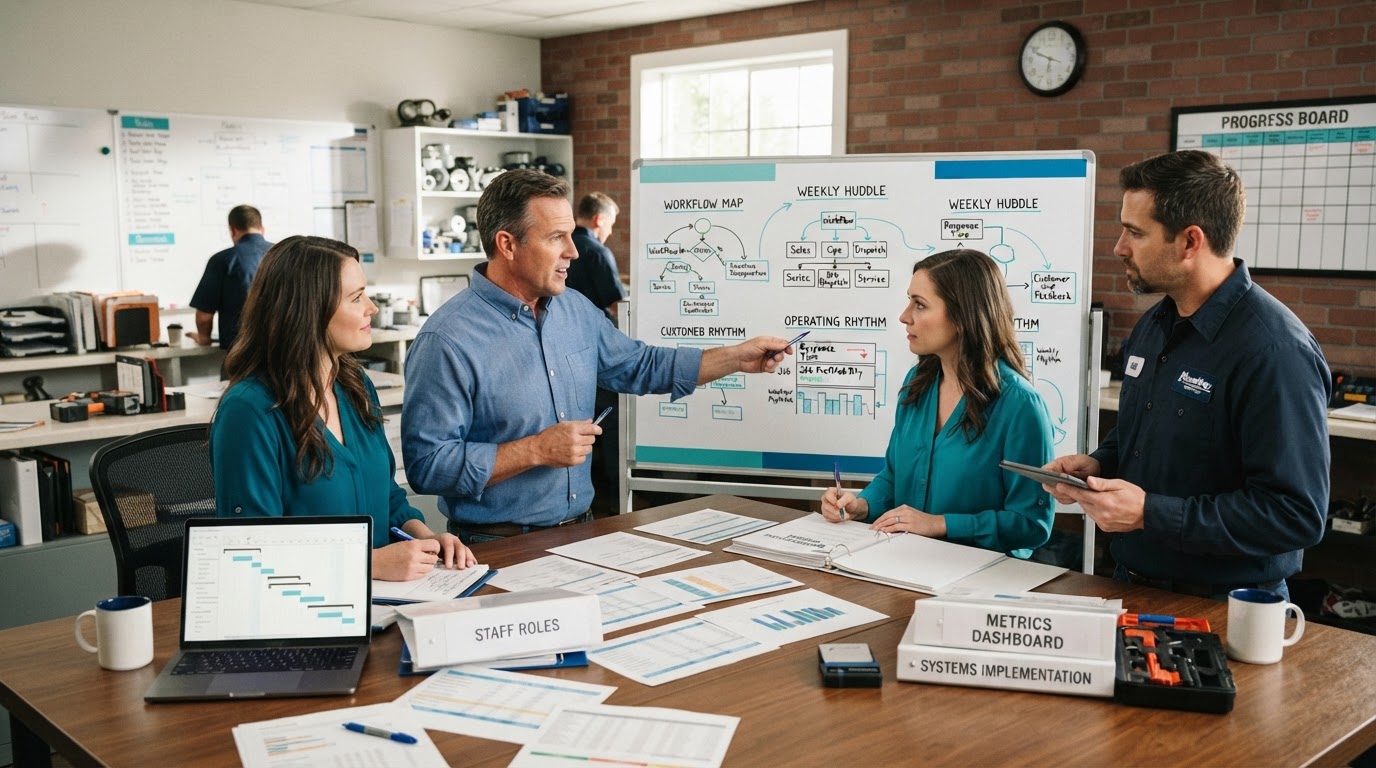
For plumbing companies, that rhythm can connect dispatch, field operations, and office work. A daily huddle can surface route issues, urgent customer needs, parts shortages, and schedule changes before the day starts. Weekly planning can review backlog, upcoming installs, callbacks, and staffing needs. Simple, repeated meetings create calm because the team knows when issues will be handled and who is responsible for each one.
Which metrics matter most when founder stress is rising?
The most useful metrics are the ones that show whether the business is healthy before the founder feels the pressure. In plumbing, that usually means job flow, schedule utilization, callback rates, estimate conversion, invoice timing, gross margin, and cash flow visibility. If the numbers are clear, the founder can lead based on reality instead of reacting to surprises.
Simple Operations emphasizes tracking progress, not just activity. That means the team should see a few meaningful numbers often enough to act on them. Metrics should help answer basic questions: Are the trucks productive? Are jobs profitable? Are callbacks increasing? Are estimates converting? Is cash moving the right way? When the right numbers are visible, stress drops because ambiguity drops with it.
How do projects and culture make delegation stick?
Projects and culture make delegation stick by turning good intentions into habits. A project with one owner, a deadline, and a clear outcome is much easier to manage than a vague group effort. Culture then reinforces the behavior so accountability becomes normal instead of awkward. Without culture, delegation becomes temporary. Without projects, it becomes vague.
For plumbing companies, this means recurring improvements like dispatch cleanup, estimate consistency, truck stock discipline, permit follow-up, and review management need owners and review points. The company also needs a culture where people tell the truth early, ask for help before things break, and take responsibility for results. Simple Operations calls this a culture of accountability, and it matters because systems only work when people actually use them.
Key takeaways
- Revenue growth in a plumbing company can increase stress when the founder is still the default decision-maker.
- Building systems before hiring helps new team members succeed without creating more founder dependence.
- Clear roles and decision rights reduce the number of questions that route back to the founder.
- Daily huddles and weekly planning reduce firefighting by creating a predictable time to handle issues.
- Plumbing companies need visibility into job flow, utilization, callbacks, estimate conversion, invoice timing, and margin signals.
- A culture of accountability makes delegation stick instead of turning into temporary delegation theater.
Putting it into practice
- Step 1
Map the bottlenecks
List where work stalls most often: dispatch, estimates, parts, customer escalations, permits, or invoicing. - Step 2
Assign clear owners
Give each critical function one clear owner so the team knows who decides and who follows through. - Step 3
Install a daily rhythm
Use a short daily huddle to surface urgent issues, confirm priorities, and prevent surprises later in the day. - Step 4
Track a small set of metrics
Choose a few job and margin numbers that show whether the business is healthy before the founder feels the pain. - Step 5
Make projects visible
Turn important improvements into owner-assigned projects with deadlines, not loose goals everyone assumes someone else will handle. - Step 6
Reinforce accountability in culture
Reward direct communication, early escalation, and follow-through so the team learns that ownership is expected.
Questions founders ask
Why is my plumbing business more stressful as it grows?
Because growth often increases complexity faster than the company’s systems can absorb it. More work, more customers, and more moving parts can overwhelm a founder who is still the main decision-maker.
Should I hire before I build systems?
Usually no. Hiring without clear roles and rhythms often creates more confusion. Building systems first makes new hires easier to manage and helps them succeed faster.
What is the biggest founder bottleneck in a plumbing company?
It is often the founder being required for too many decisions. That creates delays in dispatch, estimates, escalations, and follow-through.
What should a growing plumbing company track each week?
Track the few numbers that show operational health, such as job flow, utilization, estimate conversion, callback trends, invoice timing, and margin signals.
How do daily huddles help plumbing operations?
They create a predictable time to surface issues, confirm priorities, and assign ownership before the day gets away from the team.
What makes delegation safer for plumbing founders?
Clear roles, clear decision rights, and regular rhythms. Delegation becomes safer when people know what they own and when to escalate.