
Building a Management Team for a Growing Plumbing Company
Unlock Operational Freedom in Your Business
Revenue growth should make a plumbing company stronger, not make the founder feel trapped. When stress rises with sales, it usually means the business has outgrown informal decision-making. The answer is not more hustle. It is a simple operating layer that clarifies ownership, creates rhythm, and helps the team solve problems without waiting on the founder.
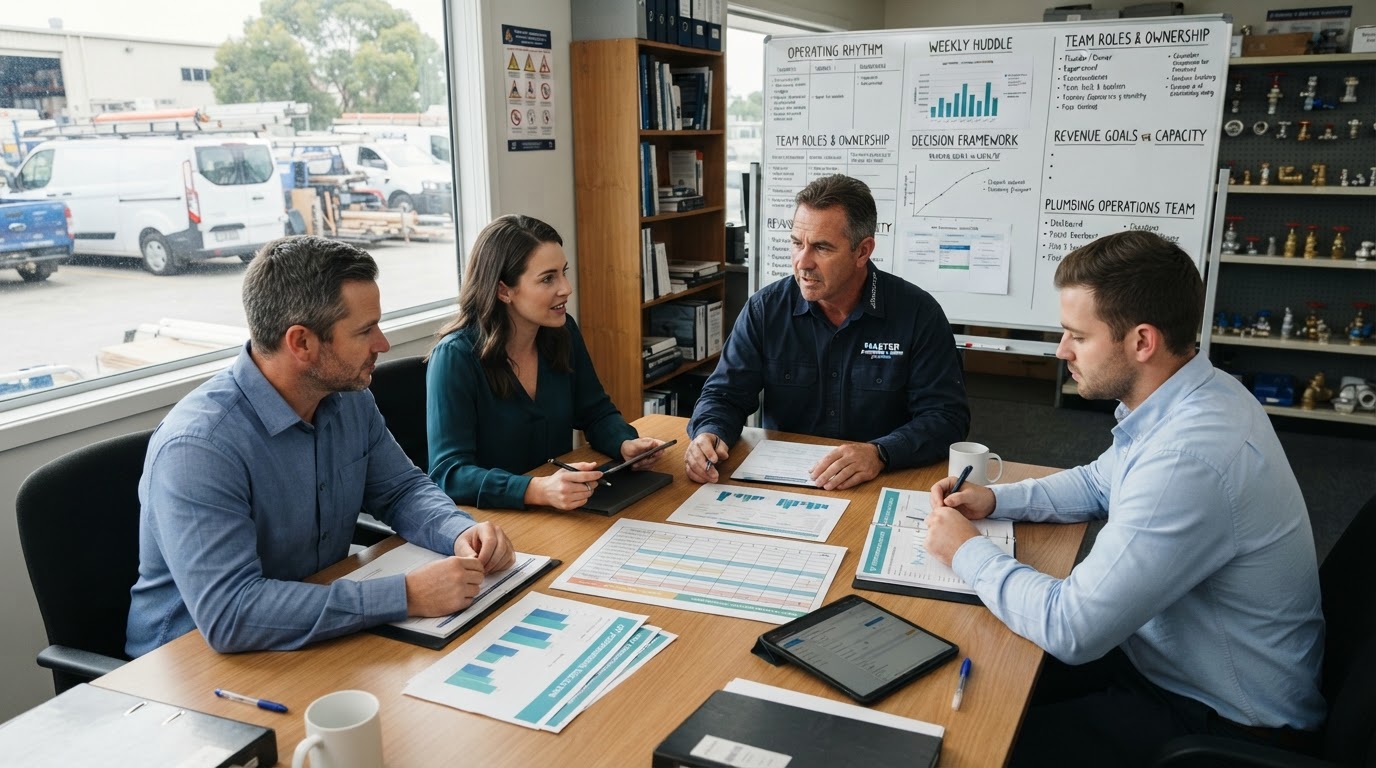
The short answer
When plumbing revenue grows but founder stress rises, the issue is usually founder dependence. Simple Operations helps companies build a practical management layer with roles, rhythms, metrics, projects, and culture so dispatch, estimates, escalations, and follow-up stop routing through one person.
Reviewed by Gabe ArnoldUpdated
Why does plumbing growth make founder stress rise?
Revenue growth raises stress when the company’s systems can’t absorb the added complexity. In plumbing, that shows up fast: urgent calls, dispatch changes, quote questions, parts delays, callbacks, permits, and customer escalations all create more moving parts than one founder can hold comfortably.
The real issue is usually not demand. It is decision volume. The founder becomes the default answer for pricing exceptions, technician problems, job changes, and customer recovery because the team does not yet have clear rules for what they can handle. That creates context switching, longer days, and the feeling that every issue still depends on one person.
What bottlenecks usually show up first in a growing plumbing company?
The first bottlenecks are usually decision bottlenecks, not technical ones. The founder becomes the approval gate for estimates, schedule shifts, refunds, callbacks, and tough customer conversations. That slows response time and forces the office and field teams to wait instead of act.
You may also see inconsistent workflows. One dispatcher handles a call one way, another handles it differently. One technician documents thoroughly, another improvises. One manager escalates early, another waits too long. When the process lives in people’s heads, quality depends on whoever is working that day, and the founder ends up cleaning up the gaps.
How do roles and delegation reduce founder overload?
Clear roles reduce overload because they remove guesswork about who owns what. Simple Operations is built around roles, rhythms, metrics, projects, and culture, and roles are the starting point. In a plumbing company, that means defining ownership for dispatch, estimating, parts coordination, callbacks, and customer escalation paths.
Delegation works best when it is specific. The founder should not hand off “more responsibility” and hope for the best. Instead, the team needs decision boundaries: what they can decide alone, what they should recommend, and what must be escalated. The Four Levels of Delegation help founders move from doing to directing without losing standards or creating chaos.
What rhythms keep a plumbing team aligned without constant interruptions?
Rhythms create calm because they give problems a place to land. A growing plumbing company needs a simple cadence for daily dispatch coordination, weekly planning, and regular review of open issues, missed follow-ups, and job status. Without that rhythm, every question feels urgent and every interruption feels personal.
Meetings must have meaning. For plumbing companies, that means short, purposeful check-ins that keep office staff and field teams aligned on priorities, handoffs, and exceptions. The goal is not more meetings. It is fewer random interruptions, faster decisions, and a shared operating rhythm that keeps the day from being run by whoever shouts loudest.
Which metrics matter most when founder stress is rising?
The right metrics help the founder lead without guessing. In plumbing, useful metrics are the ones that reveal job flow, delivery quality, and margin health before problems become fires. You want a small set of visible numbers that show whether dispatch is working, callbacks are under control, quotes are being completed, and the team is finishing jobs cleanly.
Simple Operations emphasizes tracking progress, not just activity. That means watching numbers that tell the truth about the business, not vanity metrics. When the team can see what matters, they can act earlier. The founder gets less ambushed, the office gets less reactive, and the company stops confusing busyness with health.
How do projects and culture make delegation stick?
Projects and culture make delegation last. A plumbing company can define roles and rhythms, but if projects are vague and accountability is weak, everything slides back to the founder. Each major initiative should have a single owner, a clear outcome, and visible checkpoints so the team knows what done looks like.
Culture is what keeps that structure from feeling mechanical. Simple Operations teaches radical transparency, ownership, and clarity as kindness. In practice, that means people say when something is off, ask for help early, and take responsibility instead of hiding problems until they explode. Over time, the business becomes less dependent on founder heroics and more capable of repeatable wins.
Key takeaways
- Plumbing founder stress often signals that growth has outpaced the company’s roles, rhythms, metrics, projects, and culture.
- In a growing plumbing company, the first bottleneck is often decision-making, not demand.
- Clear ownership reduces escalation pressure because the team knows who handles dispatch, follow-up, and job issues.
- A simple weekly rhythm can prevent random interruptions from controlling the founder’s day.
- Metrics should reveal job flow and margin health before small issues become daily fires.
- Delegation sticks when each project has one owner, a clear outcome, and visible checkpoints.
Putting it into practice
- Step 1
Map founder-dependent decisions
List the recurring decisions that still route through the founder, such as estimate exceptions, schedule changes, callbacks, and customer escalations. - Step 2
Define role ownership
Assign one owner to each critical function, including dispatch, estimating, parts coordination, customer recovery, and job closeout. - Step 3
Install a simple cadence
Create short daily and weekly rhythms so the team knows when to raise issues, review priorities, and make decisions. - Step 4
Choose visible metrics
Track a small set of numbers that show job flow, quality, and margin health before problems become emergencies. - Step 5
Make projects accountable
Give each important initiative one owner, one outcome, and a clear review point so work does not drift back to the founder. - Step 6
Reinforce ownership culture
Encourage transparency, early escalation, and clear communication so accountability becomes part of how the business runs.
Questions founders ask
Why does plumbing revenue growth often increase founder stress?
Because growth adds more decisions, more handoffs, and more escalations faster than informal systems can handle. If the founder is still the default problem-solver, revenue growth usually means more pressure, not more freedom.
What is the most common bottleneck in a growing plumbing company?
The most common bottleneck is founder-dependent decision-making. Estimates, dispatch issues, callbacks, and customer complaints keep routing back to the owner because roles and decision rights are not clearly defined.
What should a plumbing founder clarify first?
Start with ownership. Clarify who owns dispatch, scheduling, estimating, parts coordination, job closeout, and escalation handling. Once ownership is visible, delegation becomes safer and faster.
How do rhythms help reduce firefighting?
Rhythms give problems a predictable place to surface. Daily and weekly check-ins let the team raise issues early, review progress, and prevent small problems from becoming urgent interruptions.
Why are metrics important in a plumbing management layer?
Metrics make the work visible. When the team tracks the right numbers, the founder can spot problems sooner, lead with facts instead of guesswork, and reduce surprises in delivery and margin.
How does culture support better delegation?
Culture makes ownership normal. When transparency, accountability, and clarity are part of how the company works, people stop waiting for permission on every issue and start solving problems at the right level.