
How Plumbing Companies Can Document Processes and Handoffs
Unlock Operational Freedom in Your Business
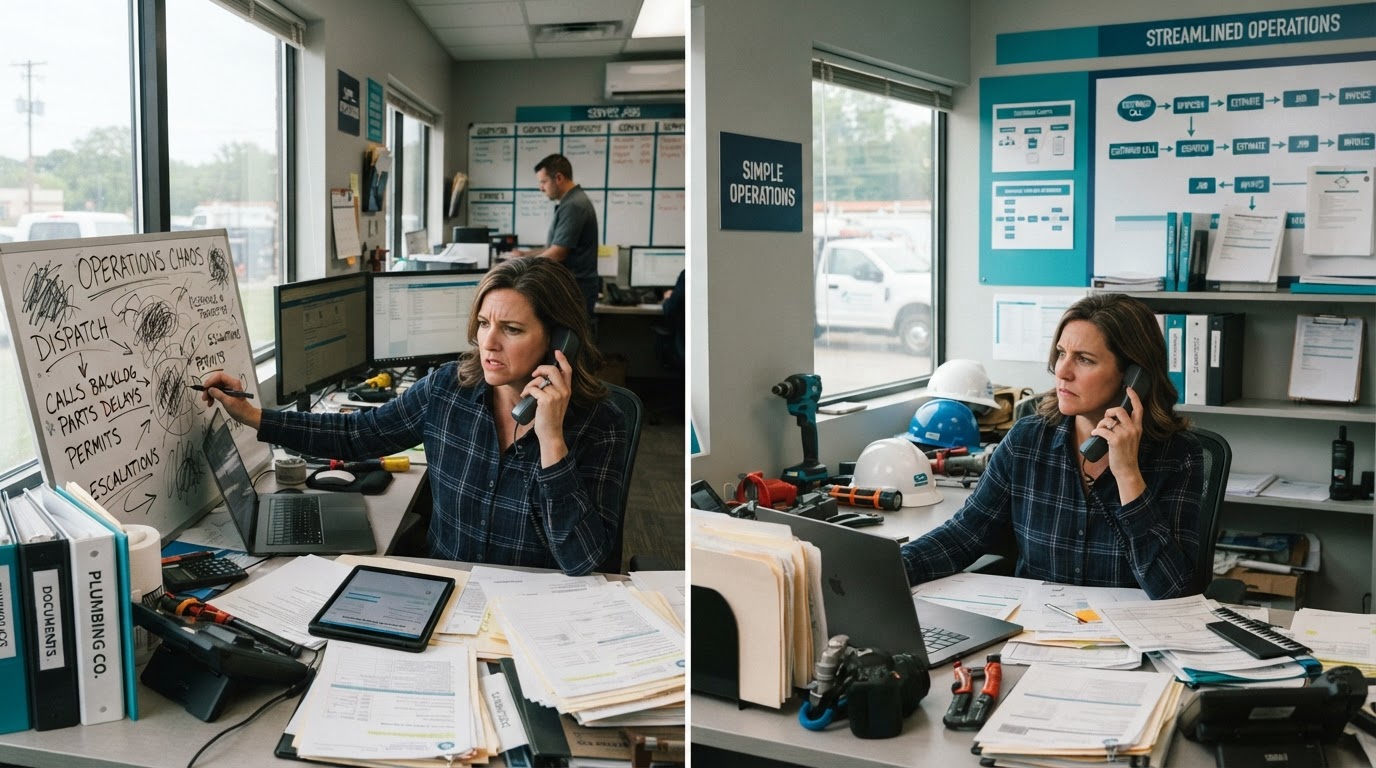
When a plumbing company grows faster than its operating model, the founder often feels the pressure first. Calls, dispatch, estimates, callbacks, parts, permits, and escalations all start routing back to one person. Simple Operations helps turn that founder dependency into a calmer, more predictable business.
The short answer
Revenue growth can raise founder stress when roles are unclear, rhythms are inconsistent, metrics are invisible, projects are ownerless, and culture still depends on the founder to hold everything together. The fix is not more hustle. Simple Operations installs a simple operating system that protects quality while reducing daily bottlenecks.
Reviewed by Gabe ArnoldUpdated
Why does plumbing revenue growth make founder stress rise?
Revenue growth raises stress when a plumbing company still depends on the founder for too many decisions. As more calls, jobs, and people enter the mix, urgency rises faster than clarity. That creates constant context switching, more interruptions, and a founder who becomes the default answer key for every problem.
In plumbing, the pressure shows up quickly because the work is time-sensitive and highly operational. Dispatch, estimating, route changes, inventory, callbacks, permits, and customer escalations all compete for attention. If the company has not documented how decisions get made, the founder ends up doing hidden work all day just to keep the business moving.
What bottlenecks usually show up first in a growing plumbing company?
The first bottlenecks are usually decision bottlenecks, not labor bottlenecks. The company may have technicians and office staff, but people still pause and wait for the founder to weigh in. That slows dispatch, delays estimates, and makes customer issues linger longer than they should.
You will also see process inconsistency. One person handles reschedules one way, another person does it differently, and the founder steps in when the result feels off. Over time, the business starts to depend on memory instead of repeatable standards. That is exhausting for the founder and confusing for the team.
How do roles and delegation reduce founder overload?
Clear roles reduce overload by giving every person one obvious lane of responsibility. In Simple Operations, delegation works best when ownership is visible and decisions are tied to specific roles rather than routed back to the founder. That is how the business stops treating the founder as the backup plan for everything.
For a plumbing company, that might mean one person owns dispatch, one owns estimates, one owns parts coordination, and one owns customer follow-up. The point is not to add bureaucracy. The point is to make it obvious who handles what, when they should escalate, and what decisions they can make without permission.
What rhythms help a plumbing team stay aligned without constant interruptions?
Rhythms reduce stress by giving the team a predictable time and place to solve problems. Without them, every issue becomes urgent and every question becomes an interruption. With them, people know when to raise concerns, review priorities, and confirm what gets done next.
Simple Operations uses targeted interactions, not open-ended meetings. A daily huddle keeps the team aligned on today’s work. A weekly check-in keeps priorities clear. Monthly and quarterly planning create room for bigger decisions before the business drifts into firefighting. For plumbing teams, this matters because dispatch and field work change fast, and rhythm keeps that motion organized.
Which metrics matter most when founder stress is rising?
The right metrics show problems early, before they turn into escalation. When a plumbing founder is stressed, it usually means the company is measuring too little or reacting too late. A small set of meaningful numbers is better than a pile of reports nobody uses.
Useful metrics often include booked jobs, close rate, callback volume, schedule utilization, estimate turnaround time, invoice speed, and gross margin by job type. The goal is not to track everything. The goal is to see whether the business is healthy enough to grow without the founder constantly translating the numbers.
How do projects and culture make delegation stick?
Delegation sticks when projects have one owner and the culture supports accountability. If projects are shared loosely, nobody fully owns the result. If the culture punishes questions or hides mistakes, people will keep waiting for the founder instead of stepping up.
Simple Operations emphasizes repeatable wins, transparent ownership, and learning from setbacks. That helps a plumbing team move from blame and confusion to clarity and follow-through. When the founder stops being the only source of standards, the business becomes more stable, and quality becomes something the system protects.
Key takeaways
- Plumbing founder stress often rises when revenue outpaces the company’s ability to absorb complexity.
- Decision bottlenecks are usually the first sign that a growing service business is still founder-dependent.
- Clear roles make delegation safer because people know what they own and when to escalate.
- Daily huddles and weekly check-ins reduce interruptions by giving the team a predictable rhythm.
- A small set of metrics is more useful than a pile of reports nobody uses.
- Repeatable processes protect quality when dispatch, estimates, callbacks, and escalations start moving faster.
Putting it into practice
- Step 1
Map the recurring founder interruptions
List the questions, approvals, and escalations that keep landing back on the founder. Group them into dispatch, sales, service, finance, and customer follow-up so you can see where the bottlenecks really are. - Step 2
Assign one owner to each critical workflow
Give dispatch, estimates, parts coordination, callbacks, and customer communication a single point of ownership. Shared responsibility sounds fair, but it usually creates confusion. - Step 3
Install a simple meeting rhythm
Use a daily huddle for immediate priorities, a weekly planning check-in for commitments, and a monthly review for bigger issues. The goal is to move decisions into the right container. - Step 4
Track a few job health metrics
Choose metrics that show whether the business is running cleanly, such as close rate, callback volume, schedule utilization, and invoice timing. Review them consistently so surprises show up early. - Step 5
Write the operating standards the team actually uses
Document the few processes that matter most in plain language. Keep them short enough that technicians and office staff will actually follow them during a busy day.
Questions founders ask
Why does a plumbing company feel harder to run as it grows?
Because growth adds complexity faster than informal habits can absorb it. More jobs, more calls, more people, and more exceptions create pressure unless the business has clear roles, rhythms, and standards.
Is delegation safe in a plumbing business with urgent calls?
Yes, if delegation is defined well. People need decision rights, escalation rules, and clear standards so they can act quickly without asking the founder about everything.
What is the biggest warning sign that the founder is becoming the bottleneck?
When the same questions, approvals, and escalations keep returning to the founder, the business is too dependent on one person for daily movement.
How can process documentation help a plumbing company?
Process documentation turns tribal knowledge into repeatable work. It helps office and field teams handle dispatch, estimates, callbacks, and follow-up consistently without relying on memory.
Do more tools fix founder stress?
Usually not. Tools can track work, but they do not create role clarity, decision rights, or accountability by themselves. The operating model has to come first.