
How Roofing Company Founders Can Reduce Daily Firefighting
Unlock Operational Freedom in Your Business
When a roofing company’s revenue grows but founder stress rises, it usually means the business has outgrown founder memory, informal handoffs, and constant interruption. The answer is not more hustle. It is clearer roles, steadier rhythms, visible metrics, owner-assigned projects, and a culture that makes accountability normal.
The short answer
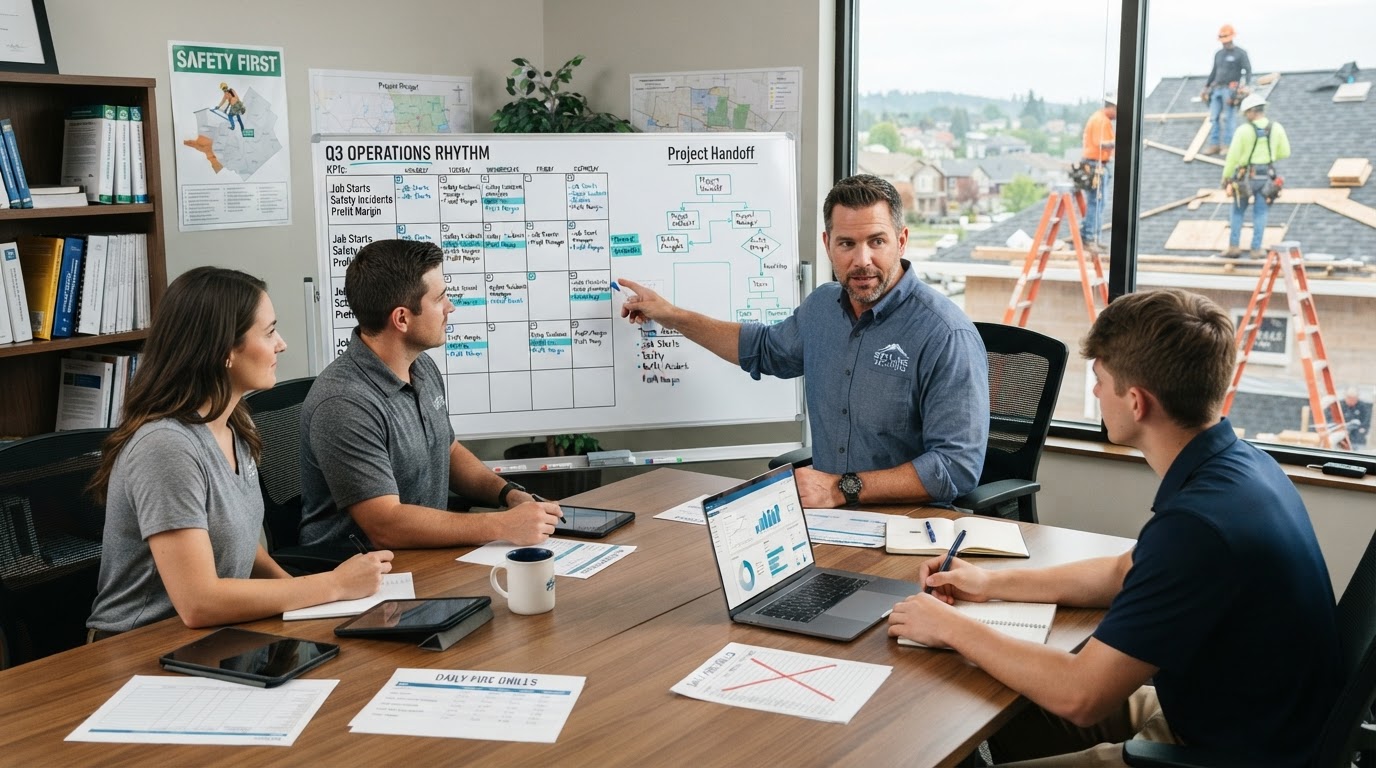
Roofing founders feel heavier as revenue grows when estimating, scheduling, materials, callbacks, and customer escalations keep routing back through them. Simple Operations helps replace that bottleneck with five operating principles: roles, rhythms, metrics, projects, and culture. The goal is not bureaucracy. It is a business that can handle more work without making the founder the default answer for everything.
Reviewed by Gabe ArnoldUpdated
Why does roofing revenue growth make founder stress rise?
Roofing growth raises stress when demand increases faster than the company’s ability to decide, coordinate, and follow through. In a roofing business, that usually shows up as slower estimates, more callbacks, more schedule changes, and more questions landing on the founder instead of being handled by the team.
The real issue is often not effort. It is founder dependence. If every customer complaint, crew issue, material delay, or insurance question still needs the founder’s approval, the business gets more complicated every time revenue grows. The founder becomes the traffic jam.
What bottlenecks usually show up first in a growing roofing company?
The first bottlenecks are usually decision bottlenecks, handoff gaps, and inconsistent execution. In roofing, that can mean sales promising one thing while operations hears another, crews waiting on answers, or project status living in someone’s head instead of a shared system.
Common pressure points include lead-to-estimate response delays, scope creep, material coordination, job-site safety issues, warranty callbacks, and poor visibility into project margins. When those problems are not tracked early, they become founder interruptions later.
How do roles and delegation reduce founder overload?
Roles and delegation reduce overload by making ownership visible before a problem becomes urgent. When one person owns estimating, one owns scheduling, one owns materials coordination, and one owns customer communication, the founder stops being the default relay point for every issue.
Delegation works best when the team knows what they own, what good looks like, and when to escalate. That is where the Four Levels of Delegation matter: some decisions need founder approval, some need a recommendation first, and some should be handled without waiting. Clear decision rights reduce second-guessing and protect quality.
What rhythms help a roofing team stay aligned without constant interruptions?
Rhythms keep a roofing company aligned because they create a predictable time and place for decisions, updates, and problem-solving. Without a cadence, the founder gets interrupted all day by texts, calls, and random questions that could have been handled in a meeting.
Simple Operations uses targeted interactions rather than ad hoc chaos. Daily huddles, weekly planning, and regular check-ins help crews, office staff, and leadership stay aligned on active jobs, upcoming installs, escalations, and priority shifts. The goal is fewer surprises, not more meetings.
Which metrics matter most when founder stress is rising?
When founder stress is rising, the most useful metrics are the ones that reveal whether growth is profitable and manageable, not just busy. For roofing companies, watch response speed, estimate-to-close conversion, schedule reliability, rework and callbacks, project margin, cash flow, and customer communication health, especially after storms or during peak season.
Metrics matter because stress is often a lagging indicator. If the founder is feeling pressure before the numbers fully show it, the business may already be drifting into hidden inefficiency. Visible metrics help the team spot trouble early and make better decisions without waiting for the founder to notice everything.
How do projects and culture make delegation stick?
Projects and culture make delegation stick by converting good intentions into habits the team can repeat without the founder stepping in. Every project needs one clear owner, defined deadlines, and a visible next step; otherwise it becomes another task to chase. Culture adds accountability, so improvements become standard practice instead of a short-lived push.
In a roofing company, that means each important initiative needs a single owner, a clear outcome, and a follow-up rhythm. Culture then reinforces the behavior: people bring solutions, updates happen on time, and missed handoffs are addressed directly. That is how the business gets lighter as it grows.
Key takeaways
- Revenue growth should create capacity, not more firefighting.
- In a roofing company, founder stress often points to a bottleneck in decision-making, not a lack of effort.
- Clear roles reduce repeat questions, handoff confusion, and constant founder interruptions.
- A regular cadence helps the team solve issues on schedule instead of in random crisis mode.
- Metrics make hidden operational strain visible before it turns into rework, callbacks, or margin loss.
- Projects stick when each one has a single owner and a culture that expects follow-through.
Putting it into practice
- Step 1
Map the founder bottleneck
List the decisions, escalations, and approvals that still route through you. In roofing, that often includes estimating, scheduling, customer complaints, change orders, and margin questions. - Step 2
Assign one owner per critical function
Clarify who owns estimating, materials, field coordination, customer communication, and closeout. Avoid shared ownership that really means nobody owns it. - Step 3
Install a simple weekly cadence
Use a predictable rhythm for updates, problem-solving, and commitments. Keep the meetings intentional so the founder is not pulled into every issue throughout the week. - Step 4
Track a few meaningful metrics
Choose the numbers that reveal operational health early: response time, schedule reliability, callbacks, project margin, and customer communication gaps. - Step 5
Make delegation safe
Use the Four Levels of Delegation so the team knows what they can decide, what they should recommend first, and what still needs founder input.
Questions founders ask
Why does a roofing company feel harder to run as revenue grows?
Because growth adds complexity faster than informal systems can absorb. More jobs, more crews, more materials, and more customer expectations create more decisions, and if those decisions still route through the founder, stress rises quickly.
Is founder stress a sign the business is failing?
No. It is often a sign the business is succeeding faster than its operating model. Stress can be a useful warning that roles, rhythms, and delegation need to catch up with demand.
What should roofing founders fix first: hiring, software, or process?
Start with process clarity before adding more people or tools. Hiring or software cannot fix unclear ownership, weak decision rights, or inconsistent handoffs. A simple operating rhythm usually creates the most relief first.
How do I know if my team is waiting on me too much?
If the same questions keep coming back, decisions stall until you weigh in, or projects move only after your push, the founder is still the system. That is a bottleneck worth addressing.
Can simple systems still work in a fast-moving roofing business?
Yes. In fact, fast-moving businesses need simple systems more than slow ones. Simple operations help the team respond faster because everyone knows what to do, who owns it, and when to escalate.