
How Roofing Company Founders Can Delegate Decisions Without Losing Control
Unlock Operational Freedom in Your Business
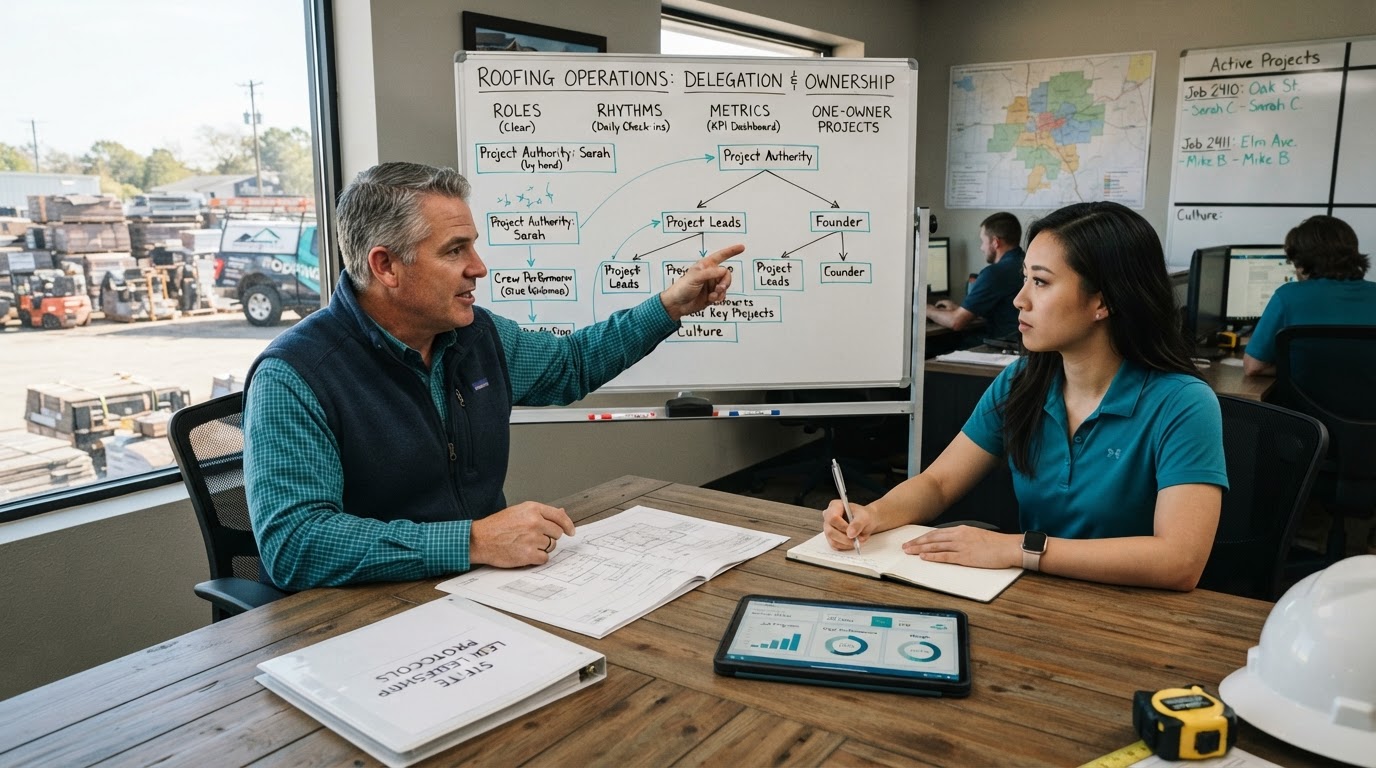
When a roofing company grows, founder stress usually rises because too many decisions still depend on one person. The fix is not to hand off everything blindly. It is to build clear roles, simple rhythms, useful metrics, one-owner projects, and a culture that makes ownership normal.
The short answer
Roofing company founders reduce stress by making ownership visible and decisions predictable. Simple Operations helps the team know who owns what, when issues get handled, and which numbers show whether the business is healthy. That turns growth from a founder bottleneck into a business the team can run with more confidence.
Reviewed by Gabe ArnoldUpdated
Why does roofing growth make founder stress rise?
Revenue growth should create capacity, but in roofing it often exposes how dependent the business still is on the founder. Estimates, scheduling, material issues, callbacks, customer updates, and margin questions all start piling up in one place, and the founder becomes the default answer for everything.
That is not a motivation problem. It is an operating model problem. If the company still relies on founder memory, informal handoffs, and fast one-off decisions, growth adds complexity faster than the team can absorb it. Simple Operations treats that as a signal to redesign how work moves.
What bottlenecks usually show up first in a growing roofing company?
The first bottlenecks usually appear where speed and quality depend on judgment, not just effort. In a roofing company, that often means delayed lead response, inconsistent estimating, unclear job scope, crew scheduling conflicts, material coordination mistakes, insurance paperwork backlogs, and escalations from crews or customers that require the founder to step in.
You can usually hear the bottleneck before you can name it. If the same questions keep coming back, the team does not need more hustle. They need clearer decision rights, better handoffs, and a simpler way to move issues forward without waiting on the founder.
How do roles and delegation reduce founder overload?
Roles reduce founder overload when ownership is defined before problems reach the founder’s desk. The estimator, production lead, office manager, service coordinator, and field leader should each know their responsibilities, the decisions they can make alone, and the specific situations that should be escalated, such as pricing exceptions, schedule changes, or customer complaints.
Simple Operations uses the Four Levels of Delegation to make that safer. Some responsibilities need step-by-step direction. Others can be owned independently once expectations are clear. The founder’s job is to move important work up the delegation ladder as people prove they can carry it well.
What rhythms help a roofing team stay aligned without constant interruptions?
Rhythms reduce interruptions by giving the team predictable places to share updates, surface problems, and make decisions. In a roofing company, that can include a brief daily huddle before crews leave, a weekly production planning meeting, and regular reviews of active jobs so issues like missing materials, weather delays, or change orders are handled early.
This is not about adding more meetings. It is about targeted interactions with a purpose. When the team trusts the cadence, they stop interrupting the founder every time something feels urgent, and the business starts making decisions on schedule instead of in crisis mode.
Which metrics matter most when founder stress is rising?
The most useful metrics are the ones that reveal problems early, not just the ones that track activity. For roofing companies, that usually includes lead response speed, estimate conversion rate, schedule reliability, gross margin by job, callback volume, and cash flow health, because together they show whether growth is creating control or stress.
Those numbers tell the founder whether growth is controlled or quietly creating strain. If the team is busy but jobs are late, margin is slipping, or callbacks are rising, the issue is not effort. It is operating discipline, and the scorecard should make that visible fast.
How do projects and culture make delegation stick?
Delegation sticks when important work has one clear owner and the culture reinforces follow-through. A roofing company needs a single owner for each project, whether that project is a systems fix, a hiring push, a client experience improvement, or a process upgrade.
Culture matters because people copy what the business rewards. If the founder keeps rescuing every issue, the team learns to wait. If the company rewards clear ownership, honest reporting, and follow-through, delegation becomes normal and the founder stops carrying every decision personally.
Key takeaways
- Revenue growth in roofing should create capacity, not make the founder the default answer for everything.
- When the same questions keep coming back, the business needs clearer roles and decision rights, not just more effort.
- A simple cadence reduces interruptions because the team knows when and where issues will be handled.
- Metrics matter most when they show whether growth is controlled, profitable, and operationally healthy.
- Delegation sticks when ownership is visible and each important project has one clear owner.
- Culture determines whether the team waits for the founder or steps up with accountability.
Putting it into practice
- Step 1
Identify the founder bottleneck
List the recurring decisions, escalations, and approvals that keep coming back to you. In roofing, pay special attention to estimates, scheduling, callbacks, materials, and customer communication. - Step 2
Clarify roles and decision rights
Assign one clear owner to each critical function and define what they can decide without asking first. Use delegation levels so the handoff matches the person’s capability. - Step 3
Install a simple rhythm
Create a short daily and weekly cadence for updates, issues, and planning. The goal is to reduce random interruptions and make decisions happen on schedule. - Step 4
Track a few meaningful metrics
Use numbers that reveal health early, such as lead response, estimate conversion, margin, callbacks, and schedule reliability. Review them often enough to act, not just admire them. - Step 5
Make accountability part of culture
Reinforce ownership in meetings, follow-through, and praise. When the team sees that clear ownership is expected and supported, delegation becomes easier to sustain.
Questions founders ask
Why does roofing growth make founders feel more stressed?
Because growth adds complexity faster than informal operations can absorb it. The founder gets pulled into more decisions, more escalations, and more coordination unless roles and rhythms are clear.
Is the problem really delegation or something deeper?
Usually something deeper. Delegation fails when decision rights, expectations, and follow-up rhythms are unclear. The issue is not simply handing off work; it is building conditions that make ownership safe.
What should a roofing founder fix first?
Start with the biggest decision bottleneck and the most repeatable escalation path. Then clarify the role, install a simple rhythm, and define what success looks like for that owner.
How do I know if my company is too founder-dependent?
If the same questions, approvals, and emergencies keep routing through you, the company is founder-dependent. Another sign is that the business feels fragile whenever you step away.
Do more meetings solve founder stress?
Not by themselves. Meetings only help when they are targeted, short, and tied to ownership and decisions. Random or overly long meetings usually add to the stress.
Can Simple Operations help without making the company feel corporate?
Yes. The point is simple structure, not bureaucracy. The system is designed to make the business lighter, clearer, and easier to lead.