
How Roofing Companies Can Remove Bottlenecks as Revenue Grows
Unlock Operational Freedom in Your Business
When revenue rises but the founder feels more stressed, the issue is usually not demand. It is that roofing operations have outgrown founder-dependent decision-making, so estimates, scheduling, customer escalations, material problems, and margin questions still flow back to one person. Simple Operations helps replace that bottleneck with a clearer operating rhythm.
The short answer
Roofing growth should create more capacity, not more pressure. When stress rises with revenue, it usually means roles are unclear, decisions bottleneck at the owner, workflows vary by job, and the team depends too much on founder intervention. Simple Operations installs an operating model built on roles, rhythms, metrics, projects, and culture.
Reviewed by Gabe ArnoldUpdated
Why does revenue growth make a roofing founder feel heavier?
Revenue growth makes a roofing founder feel heavier when the company adds more jobs, more moving parts, and more decisions faster than the operation can absorb. In roofing, that often shows up as slower estimating, scheduling friction, material delays, callback chaos, and too many questions landing on the founder every day.
The founder becomes the default answer for sales, operations, and jobsite problems. That creates constant context switching and makes the business feel busy but not controlled. The real issue is not ambition. It is that the company’s operating structure has not caught up with its growth.
What bottlenecks usually show up first in a growing roofing company?
The first bottlenecks are usually decision bottlenecks, response-time bottlenecks, and handoff bottlenecks. A roofing company may be getting more leads, but estimates move slowly because approvals are unclear. Jobs may start, but scheduling or materials coordination breaks down. Crews may finish work, but closeout and warranty follow-up stay stuck.
When those issues happen, the founder gets pulled into pricing exceptions, scope changes, unhappy customers, vendor delays, and crew questions. That is a strong signal that the business needs clearer ownership and more repeatable workflows, not just more effort.
How do roles and delegation reduce founder overload?
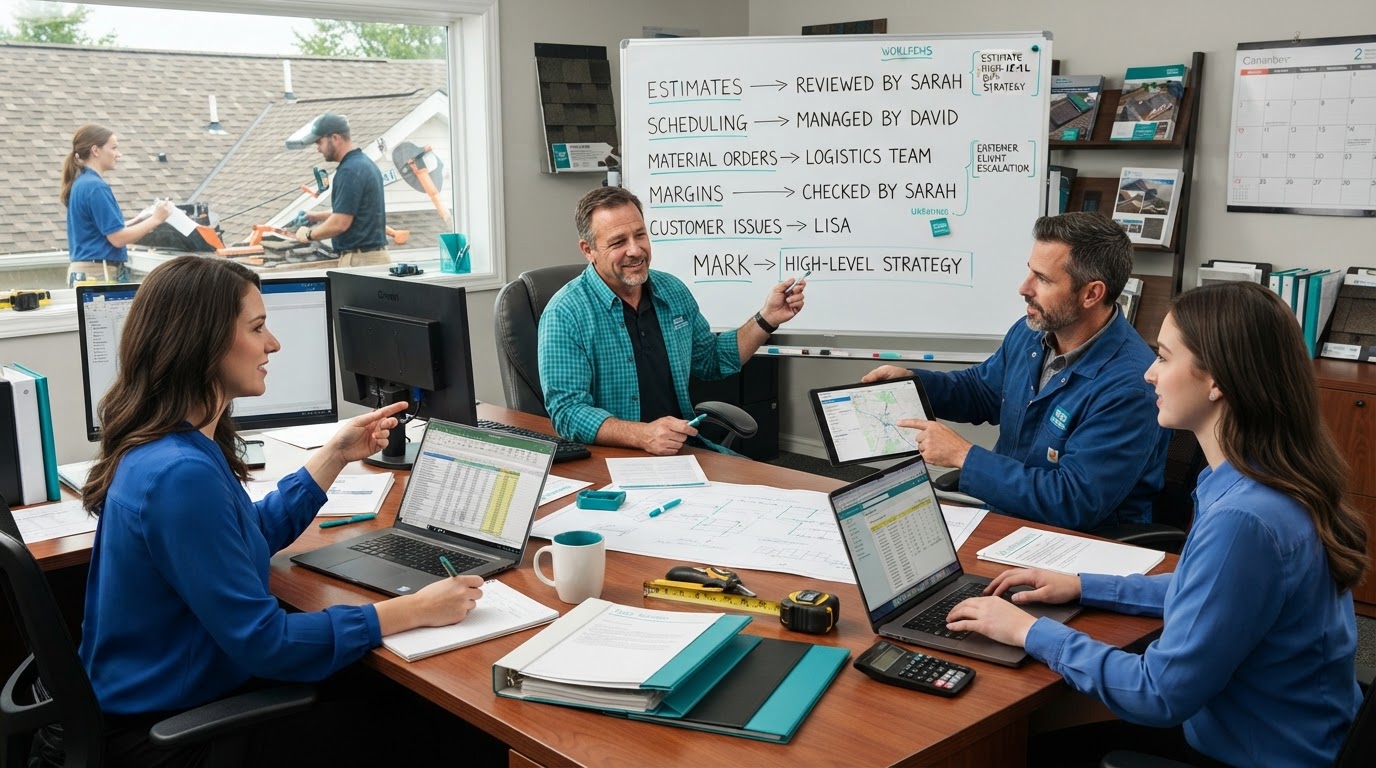
Roles and delegation reduce founder overload by making ownership visible and decision-making faster. In a roofing business, the owner should not be the person everyone asks before moving forward. Instead, each role needs clear responsibilities, clear boundaries, and clear results so people can act without waiting for permission.
Simple Operations uses the Four Levels of Delegation to match the level of trust, coaching, and authority to the person and the task. Delegation is not just handing off work. It is creating the conditions where the team can own outcomes, escalate the right issues, and stop bouncing everything back to the founder.
What rhythms help a roofing team stay aligned without constant interruptions?
A roofing team stays aligned when the business has a simple cadence instead of random check-ins and reactive meetings. Daily and weekly rhythms create predictable times to surface issues, review priorities, and keep jobs moving. That reduces the “do you have a minute?” interruptions that drain founder energy and slow the field.
The goal is not more meetings. It is meetings with meaning. Short, intentional huddles and planning conversations help office staff, estimators, project managers, and field crews know what matters now, what is blocked, and who owns the next step. Structure protects time.
Which metrics matter most when founder stress is rising?
The most useful metrics are the ones that show whether the company is healthy before problems become emergencies. Roofing founders should know the numbers that reflect lead flow, estimate speed, job progress, margin, callbacks, and closeout quality. If the founder cannot see those patterns clearly, stress usually rises because every issue feels urgent.
Simple Operations focuses on tracking progress, not just activity. That means fewer vanity numbers and more operational visibility. When the right metrics are reviewed consistently, the team can spot slowdown, protect profit, and make better decisions without waiting for the owner to notice everything first.
How do projects and culture make delegation stick?
Projects and culture make delegation stick by turning good intentions into repeatable behavior. Roofing companies often have plenty of urgency, but urgency alone does not create follow-through. Projects need one owner, clear outcomes, and a timeline. Culture needs accountability, transparency, and a shared expectation that work gets finished the right way.
Simple Operations treats culture as a daily operating choice, not a slogan. When the team knows how to raise issues, how to own results, and how to leave each system better, delegation stops feeling risky. That is how the founder gets out of the center without quality slipping.
Key takeaways
- Revenue growth in roofing should create more capacity, not more founder firefighting.
- When every decision routes through the founder, the business is already signaling a bottleneck.
- Clear roles make delegation safer because people know what they own and when to escalate.
- A predictable cadence reduces interruptions by giving the team defined moments to raise issues.
- The right metrics help roofing leaders see margin, delivery, and follow-up problems before they become fires.
- Culture makes delegation stick when accountability is normal and transparency is expected.
Putting it into practice
- Step 1
Map the founder bottlenecks
List the decisions, approvals, and escalations that still depend on the founder. Look for repeated questions, slow responses, and job delays that point to missing ownership. - Step 2
Clarify roles and decision rights
Define who owns estimating, scheduling, materials, job progress, customer communication, and closeout. Make it clear what each role decides without waiting on the owner. - Step 3
Install a simple operating cadence
Use a short daily and weekly rhythm to review priorities, blockers, and active jobs. Keep it intentional so the team knows when to bring issues forward. - Step 4
Track the few metrics that matter
Choose a small set of numbers that show lead speed, project flow, margin health, and callback volume. Review them consistently so problems appear early. - Step 5
Make accountability part of culture
Reinforce ownership in meetings, reviews, and follow-up. The goal is a business where people bring solutions, finish what they start, and leave systems better.
Questions founders ask
Why does roofing growth often increase founder stress?
Because the business gets more complex faster than the operating system can absorb. More jobs, more coordination, and more customer touchpoints create more decisions, and those decisions often route back to the founder if roles and rhythms are unclear.
What should a roofing founder look at first?
Start with decision bottlenecks, response times, job handoffs, customer escalations, and which tasks still depend on the founder. Those patterns usually reveal where the operating model is too informal for the company’s current size.
How does delegation reduce stress without hurting quality?
Delegation works when responsibilities, standards, and decision rights are clear. That allows the founder to keep quality protected while the team handles more work without needing constant approval.
What kind of rhythm helps a roofing business most?
A simple, consistent cadence helps most: a daily check-in for priorities and blockers, weekly planning for active jobs, and regular reviews of key numbers. The purpose is fewer surprises and faster decisions.
Why do metrics matter so much in roofing operations?
Because they show whether work is flowing or stalling. When founders can see lead response, job progress, margins, and callbacks clearly, they can lead from data instead of chasing every problem manually.
What makes a roofing team actually follow the system?
People follow what is clear, useful, and reviewed consistently. Systems stick when the team sees that roles are real, meetings matter, and accountability is part of how the business works every week.