
How Roofing Companies Can Document Processes and Handoffs
Unlock Operational Freedom in Your Business
If your roofing company is growing but you feel more stressed, that is usually a systems problem, not a personal one. Revenue often adds complexity faster than delegation, decision rights, and management capacity can absorb, so the founder gets pulled into too many approvals, escalations, and interruptions. Simple Operations helps you build a calmer operating model around clarity, rhythm, and ownership.
The short answer
Roofing company founders often feel more stressed as revenue grows because the business becomes more complex faster than its operating model can handle. Simple Operations helps reduce founder-dependent decisions, clarify roles, install simple rhythms, track a few meaningful metrics, assign one owner to each project, and build a culture where accountability is normal.
Reviewed by Gabe ArnoldUpdated
Why does roofing revenue growth make founder stress rise?
Revenue growth usually increases stress when the company is still organized around founder memory instead of a clear operating system. In roofing, that shows up quickly because estimates, material coordination, crew scheduling, inspections, insurance documentation, and customer updates all require fast decisions. If the founder is still the default answer for everything, growth becomes heavier instead of freer.
The real issue is not demand. It is that the work of the business has outgrown the way the business is run. Simple Operations addresses that by replacing ad hoc decision-making with a simple rhythm that helps the team move without waiting on the owner for every next step.
What bottlenecks usually show up first in a growing roofing company?
The first bottlenecks are usually decision bottlenecks, communication gaps, and inconsistent job execution. A roofing founder may get pulled into estimate approvals, schedule changes, customer complaints, crew conflicts, warranty issues, and margin questions because no one else knows exactly what they own. That creates constant context switching and keeps the founder in firefighting mode.
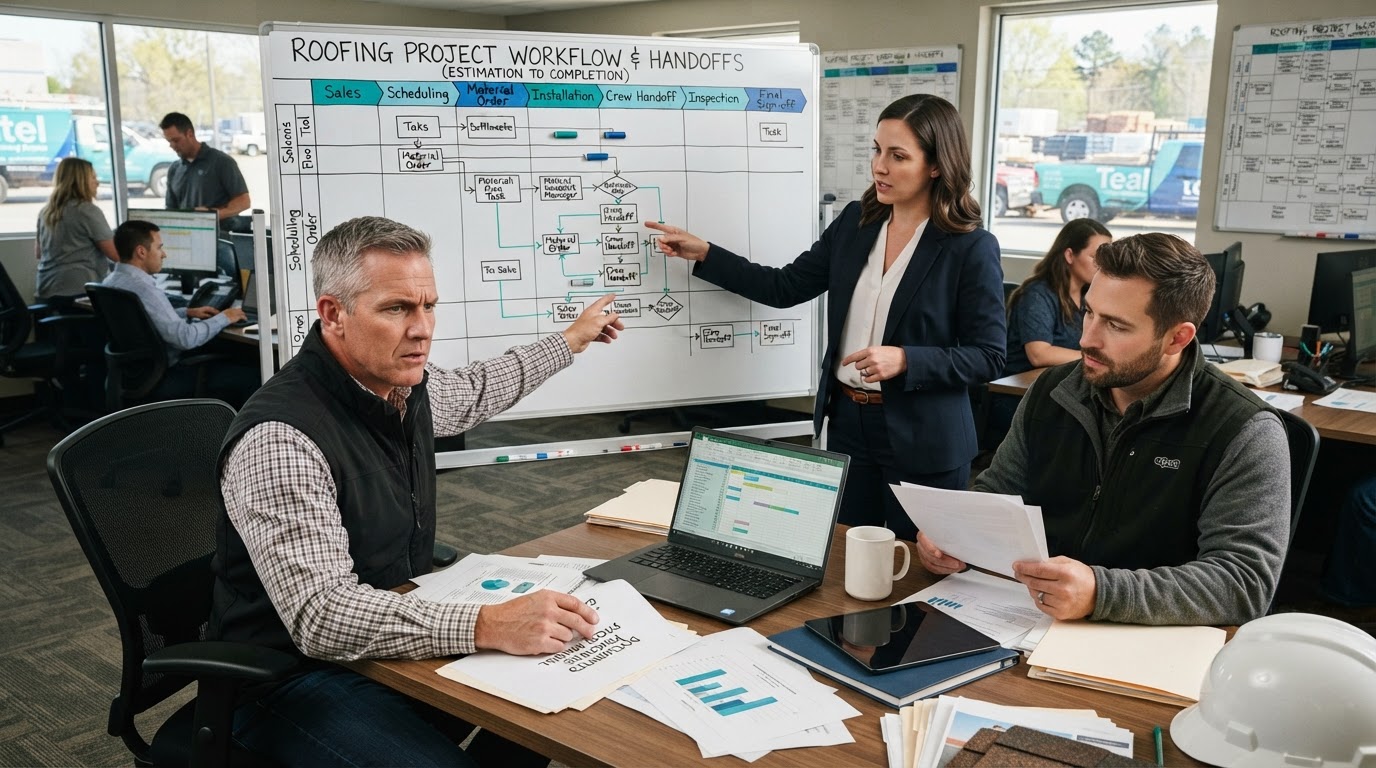
You may also see repeat questions, late handoffs between sales and operations, and jobs that depend on one person remembering the process. Those are signs that process documentation and standard operating procedures are needed, but only if they are tied to actual work, not stored in a folder no one uses.
How do roles and delegation reduce founder overload?
Clear roles reduce founder overload by making ownership visible and decisions easier to route. When people know who owns estimating, scheduling, materials, customer communication, production, and closeout, the founder stops becoming the automatic answer key. That does not mean the founder disappears; it means the founder only stays involved where the judgment truly belongs.
Simple Operations uses clarity in roles and the Four Levels of Delegation to help leaders decide what can be done independently, what should be checked, and what still requires founder input. That protects quality while building trust, which matters in roofing because mistakes can affect margin, safety, and reputation.
What rhythms help a roofing team stay aligned without constant interruptions?
A steady rhythm keeps roofing teams aligned because people know when decisions happen, when priorities are reviewed, and when issues should be escalated. Without that cadence, every problem feels urgent and the founder gets interrupted all day. With it, the team has a predictable place to surface blockers, update progress, and keep projects moving.
Simple Operations is built around targeted interactions, not endless meetings. The goal is short, purposeful conversations that move work forward. For roofing companies, that often means daily alignment, weekly planning, and regular reviews of active jobs so crews, office staff, and leadership are working from the same picture.
Which metrics matter most when founder stress is rising?
The most helpful metrics are the ones that show whether the business is healthy and where it is getting stuck. In roofing, that usually includes lead response time, estimate turnaround, project status, job margin, closeout speed, callback volume, and cash flow visibility. If those numbers are invisible, the founder ends up making emotional decisions instead of informed ones.
Simple Operations emphasizes tracking what matters, not busywork. Visible metrics help the team spot problems early, make better decisions, and protect profit before small issues become expensive ones. That is especially important when seasonality or storm-driven demand makes the business feel busy but not necessarily stable.
How do projects and culture make delegation stick?
Delegation sticks when projects have one owner, clear outcomes, and a culture that expects follow-through. If work is shared vaguely, it usually returns to the founder. If ownership is visible, the team can move without waiting for permission. That is how roofing companies turn good intentions into reliable execution.
Culture matters because process alone is not enough. Simple Operations teaches radical transparency and ownership so people tell the truth early, bring problems forward, and learn from setbacks instead of hiding them. In a roofing company, that creates fewer surprises, cleaner handoffs, and a stronger reputation with customers and crews alike.
Key takeaways
- Revenue growth can expose operational bottlenecks faster than it creates freedom.
- In roofing, founder stress often means too many decisions still route through one person.
- Process documentation only helps when it is tied to ownership, cadence, and real work.
- Clear roles reduce repeat questions and make delegation safer.
- A simple operating rhythm protects quality better than ad hoc firefighting.
- Visible metrics help roofing leaders spot margin and delivery problems early.
Putting it into practice
- Step 1
Map the repeat interruptions
List the questions, approvals, and escalations that keep coming back to you. Group them by estimating, scheduling, materials, production, customer communication, and closeout. - Step 2
Assign one owner to each recurring process
Choose one person to own each major workflow. Make responsibility visible so decisions do not default back to the founder. - Step 3
Install a simple weekly cadence
Use short, targeted meetings to review active jobs, blockers, and priorities. Keep the rhythm consistent so the team knows when issues will be handled. - Step 4
Track the few numbers that show health
Pick a small set of metrics that reveal whether the business is on track. Focus on lead response, estimate speed, job margin, callback volume, and closeout progress. - Step 5
Use delegation levels intentionally
Decide which decisions can be made independently, which should be checked, and which still need founder approval. That gives the team more room without lowering standards.
Questions founders ask
Is process documentation and standard operating procedures enough to solve founder stress?
Not by itself. Documentation helps, but it only works when it is connected to roles, rhythms, metrics, and real decision-making. In roofing, SOPs should support how the team estimates, schedules, orders materials, manages escalations, and closes out jobs.
Why does hiring more people sometimes make a roofing founder even busier?
Because more people can create more communication paths, more questions, and more decisions unless ownership is clear. Hiring before the operating model is ready often adds complexity instead of reducing it.
What should a roofing founder delegate first?
Start with repeatable work that still routes back to you: scheduling decisions, routine customer updates, estimating support, follow-up tasks, and job status tracking. Delegate in a way that matches the person’s readiness and the risk of the decision.
How do Simple Operations principles help roofing companies?
They give the business a simple operating layer: roles, rhythms, metrics, projects, and culture. That structure reduces founder dependence and makes it easier for the team to own outcomes without constant supervision.
What is the real sign that growth is becoming a problem?
When revenue rises but the founder feels more interrupted, more reactive, and less able to think strategically. In roofing, that is often the clearest signal that the business has outgrown its current way of operating.