
How Plumbing Company Founders Can Reduce Burnout
Unlock Operational Freedom in Your Business
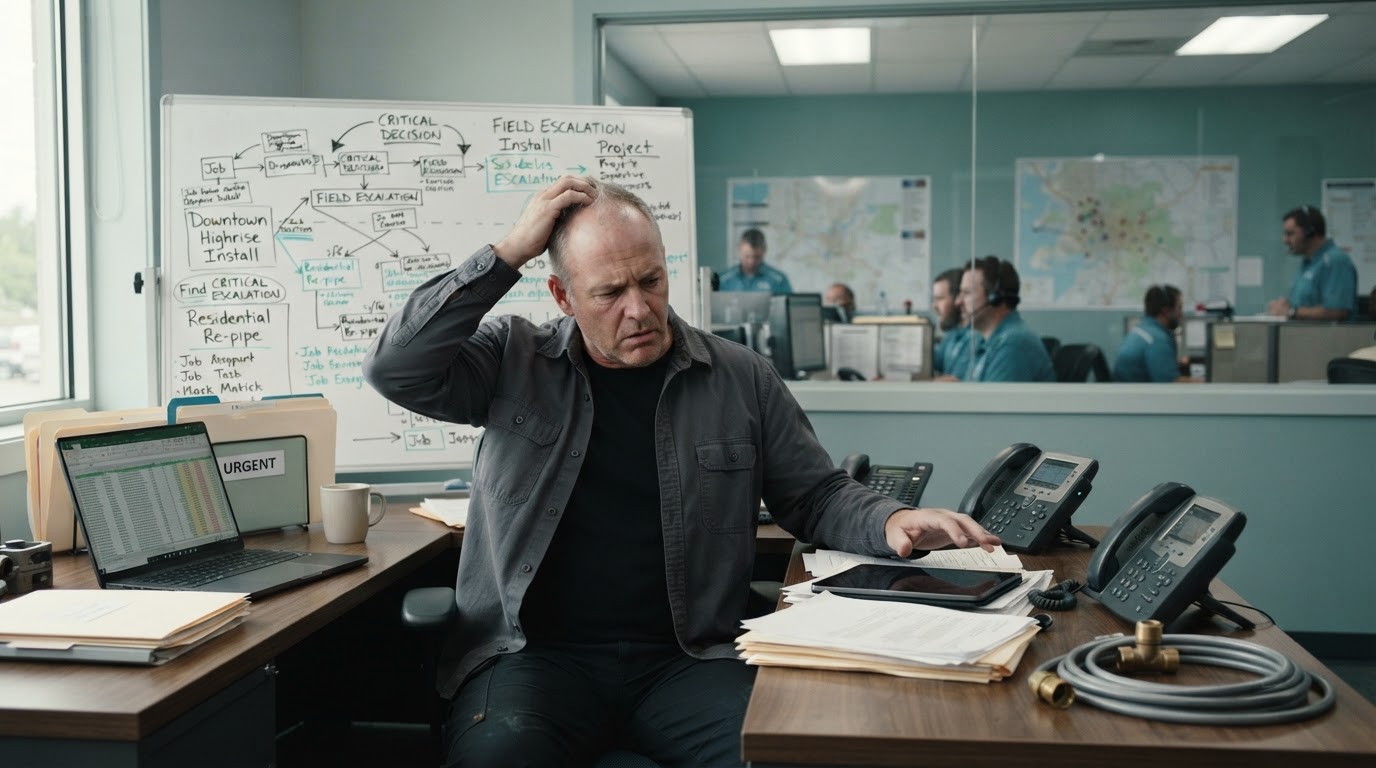
When a plumbing company grows but the founder feels more stressed, the problem is usually not demand. It is founder dependence. Revenue adds complexity faster than roles, rhythms, metrics, projects, and culture can absorb it, so the owner becomes the default solution for every decision, escalation, and exception.
The short answer
For plumbing companies, rising founder stress is often the clearest sign that the business has outgrown informal operations. Simple Operations helps founders replace constant firefighting with clear roles, reliable rhythms, visible metrics, owner-assigned projects, and a culture of accountability so the business can grow without routing everything back through one person.
Reviewed by Gabe ArnoldUpdated
Why does plumbing revenue growth make founder stress rise?
Revenue growth raises stress when the company’s operating model stays small while the workload gets bigger. In plumbing, more calls, more estimates, more dispatch changes, more parts coordination, and more escalations quickly overwhelm a founder who is still making too many decisions personally.
The issue is not that the business is failing. It is that growth is exposing bottlenecks. If the owner is still the approval gate for pricing questions, scheduling conflicts, callback decisions, vendor problems, and customer complaints, every new job adds pressure instead of relief.
What bottlenecks usually show up first in a growing plumbing company?
In a growing plumbing company, the first bottlenecks are usually decision bottlenecks rather than demand problems. The founder gets pulled into dispatch calls, quote exceptions, technician questions, customer escalations, and “quick” approvals that constantly interrupt the day, create context switching, and slow everything from scheduling to invoicing.
In plumbing companies, this often shows up as inconsistent handoffs between office and field, unclear ownership of callbacks, uneven quote quality, and slow responses to issues that should have been handled at a lower level. When those patterns repeat, the founder becomes the system instead of leading the system.
How do roles and delegation reduce founder overload?
Clear roles reduce founder overload by making ownership visible before a question turns urgent. When team members know what they own, what good looks like, and when to escalate, the founder stops becoming the answer key for routine work and can focus on higher-value decisions like hiring, margins, and growth.
Simple Operations uses clarity in roles as one of its five principles because delegation only works when the team can act without guessing. For a plumbing company, that means defining who owns dispatch, who owns estimates, who owns parts and truck stock, who owns callbacks, and who owns escalation paths.
What rhythms help a plumbing team stay aligned without constant interruptions?
Rhythms help a plumbing team stay aligned by creating predictable times for decisions, updates, and problem-solving. Instead of random interruptions all day, the team knows when to surface issues, review priorities, confirm next steps, and close loops, which keeps work moving without making the founder available for every small clarification.
Simple Operations centers this around intentional interactions, daily huddles, weekly check-ins, and planning rhythms that keep work moving. In a plumbing business, that can mean a short morning huddle for dispatch and field alignment, a weekly review of open jobs and customer issues, and a regular planning rhythm so the team is not improvising under pressure.
Which metrics matter most when founder stress is rising?
The most useful metrics are the ones that show operational health before problems become fires. For plumbing companies, that usually means looking at job volume, quote-to-book conversion, callback trends, schedule efficiency, technician utilization, margin by job type, and cash flow signals.
Simple Operations emphasizes tracking progress, not just activity. That matters because a busy team can still be underperforming. The founder needs a small set of visible numbers that reveal whether delivery, pricing, routing, and customer experience are improving or quietly slipping.
How do projects and culture make delegation stick?
Projects make delegation stick by turning priorities into owned outcomes instead of loose intentions. Culture makes it stick by making accountability normal, not personal. Without both, the team may understand the process and still drift back to asking the founder for every answer.
In Simple Operations, projects should have one owner, clear deadlines, and a visible path to completion. In a plumbing company, that might include improving dispatch flow, standardizing estimate follow-up, tightening parts restocking, or reducing callbacks. Culture then reinforces the habit of bringing solutions, not just problems.
Key takeaways
- Plumbing founder stress often signals that revenue has outgrown the company’s roles, rhythms, metrics, projects, and culture.
- The founder does not need to be the approval gate for every dispatch, quote, callback, or escalation.
- Clear ownership makes delegation safer because the team knows what it owns and when to raise issues.
- A short daily rhythm can reduce interruptions more effectively than a larger stack of tools.
- The best operating metrics are the ones that show problems before customers feel them.
- Projects stick when one person owns the outcome and the culture supports accountability.
Putting it into practice
- Step 1
Map the bottlenecks
List the decisions, escalations, and interruptions that still route through the founder. Look for repeat patterns in dispatch, estimates, callbacks, parts, and customer complaints. - Step 2
Clarify roles
Assign one owner to each major function. Make it explicit who owns scheduling, field coordination, pricing follow-up, callbacks, and internal escalation. - Step 3
Install a cadence
Create a simple daily and weekly rhythm so the team knows when to surface issues and review priorities. Keep meetings short and focused on decisions and ownership. - Step 4
Choose a few metrics
Track a small set of numbers that reveal operational health, such as quote consistency, schedule efficiency, callback trends, and margin signals. - Step 5
Make projects visible
Turn improvements into owned projects with deadlines and clear outcomes. Use one owner per project so work does not drift back to the founder. - Step 6
Reinforce the culture
Make accountability normal by asking for recommendations, not just problems. Reward clarity, follow-through, and clean handoffs.
Questions founders ask
Why do plumbing founders feel more stressed when revenue grows?
Because growth usually adds complexity faster than the company adds clarity. More jobs, more schedules, more customer issues, and more decisions can overwhelm a founder who is still central to everything.
Is the problem usually the team or the structure?
Usually the structure. Good people still need clear ownership, decision rights, and a repeatable rhythm. When those are missing, the founder gets pulled into everyday firefighting.
What should a plumbing founder fix first?
Start with the biggest bottleneck that creates the most interruptions. That is often role clarity, decision rights, or a simple daily and weekly cadence that keeps issues from bouncing back to the owner.
How do metrics reduce founder stress?
Metrics reduce stress by making problems visible earlier. When the founder can see schedule efficiency, callbacks, quote quality, or margin trends, decisions become less emotional and more practical.
Can better delegation protect customer experience?
Yes. Delegation works best when the team knows what standard to uphold and when to escalate. That creates faster responses, fewer dropped balls, and more consistent service.
What is the real goal of simple operations?
The goal is not bureaucracy. It is to build a business that runs with less friction, fewer interruptions, and more founder freedom while protecting quality and accountability.