
Why a Remodeling Company’s Growth Can Make The Founder’s Stress Rise
Unlock Operational Freedom in Your Business
As remodeling revenue grows, founder stress often rises because the business adds complexity faster than it adds structure. The answer is not more hustle or another software tool. It is a simpler operating model that clarifies roles, creates rhythm, measures what matters, and makes delegation safe enough to actually stick.
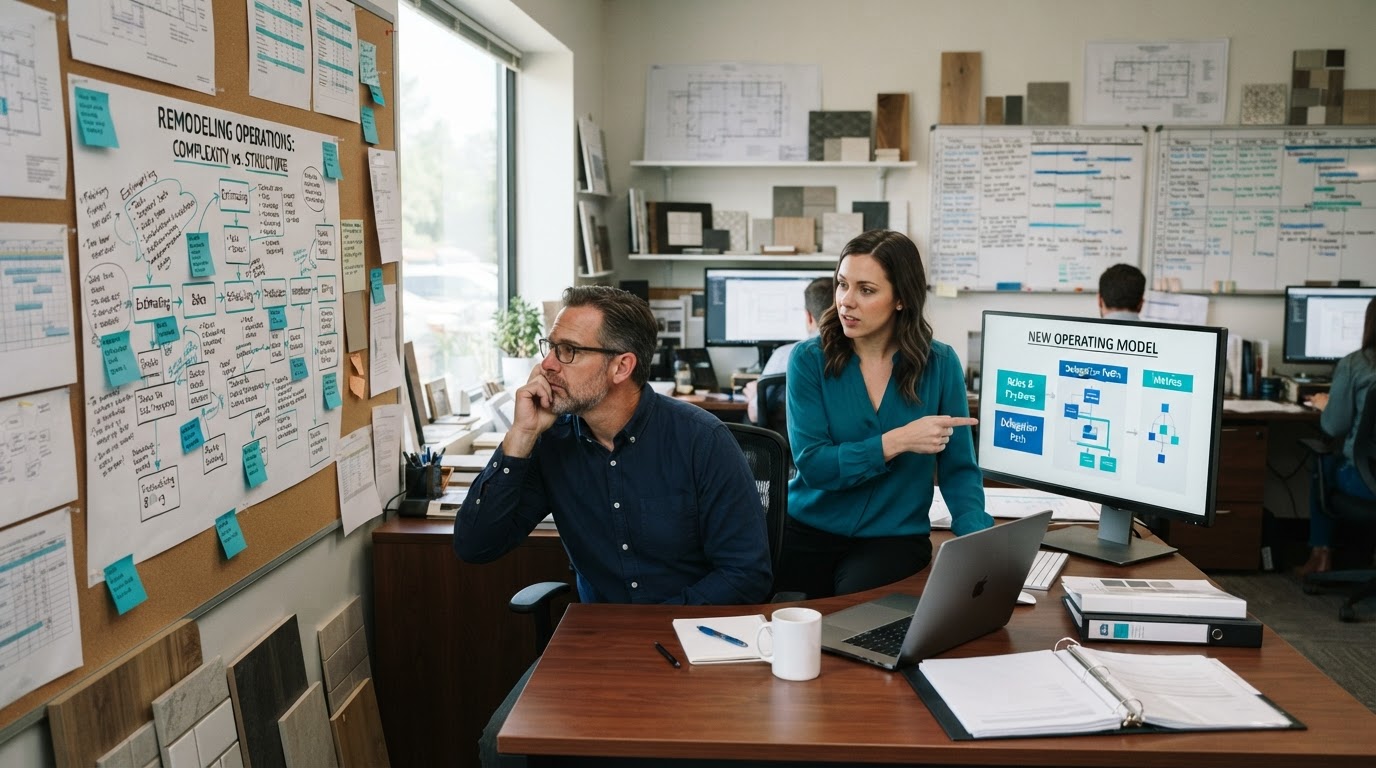
The short answer
When a remodeling company grows but the founder feels more stressed, the real problem is usually founder dependence. Simple Operations helps you reduce decision bottlenecks, create clear ownership, and install practical rhythms so the business can handle more projects without routing every issue back through you.
Reviewed by Gabe ArnoldUpdated
Why does revenue growth make a remodeling founder more stressed?
Revenue growth makes a remodeling founder more stressed when the business adds jobs, trades, clients, and exceptions faster than the operating model can absorb them. The founder stays the answer key for scheduling, scope changes, client updates, and escalations, so growth feels like pressure instead of relief.
In remodeling, complexity shows up quickly: estimates need turnaround, selections need coordination, permits and inspections need tracking, subcontractors need scheduling, and change orders need clean approval. If those decisions still route back through the founder, every new project adds more context switching. The result is more revenue on paper, but less margin, less focus, and more fatigue in real life.
What bottlenecks usually show up first in a growing remodeling company?
The first bottlenecks in a growing remodeling company are usually decision bottlenecks, not demand problems. When the founder approves every estimate, settles each client concern, or handles every vendor issue, work piles up in the office and on jobsites. Estimating, scheduling, and communication stall exactly when the business should be gaining momentum.
In remodeling companies, the early warning signs are familiar: inconsistent lead qualification, slow estimate turnaround, unclear scope tracking, weak change-order billing, delayed scheduling, and too many client questions landing in the founder’s inbox. These issues are not random. They usually point to unclear ownership and missing handoffs between sales, production, office support, and field leadership.
How do roles and delegation reduce founder overload?
Roles and delegation reduce founder overload by making ownership visible before work starts. When each person knows what they own, what they decide, and what they escalate, the founder stops being the default path for every issue. That creates speed without sacrificing quality.
Simple Operations is built around roles first because delegation fails when expectations live in the founder’s head. For a remodeling company, that means clarifying who owns lead intake, estimating, client communication, project coordination, material readiness, change orders, invoicing, punch lists, and warranty follow-up. The goal is not to hand off responsibility vaguely. It is to make the right decisions easier for the right people to make.
What rhythms help a remodeling team stay aligned without constant interruptions?
Rhythms help a remodeling team stay aligned by creating predictable times for decisions, updates, and problem-solving. Instead of interrupting people all day, the team knows when to surface issues, review progress, and confirm ownership. Weekly production meetings, daily huddles, and jobsite check-ins keep projects moving without constant pings or surprise questions.
Simple Operations uses targeted interactions, not endless meetings. That matters in remodeling because the work already has enough moving parts: trades, permits, materials, inspections, schedules, and client communication. A short daily huddle, a focused weekly planning meeting, and a clear project review rhythm can prevent many of the “quick questions” that otherwise pull the founder back into the weeds.
Which metrics matter most when founder stress is rising?
The right metrics help a founder see strain early, before problems turn into fires. In remodeling, the most useful numbers are the ones that reveal lead flow, estimate speed, project progress, margin health, schedule reliability, change-order capture, and customer follow-up.
Simple Operations teaches founders to track what matters, not vanity activity. For a remodeling company, that means watching the numbers that affect cash flow, quality, and client experience. If revenue is growing but estimate turnaround is slowing, change orders are underbilled, or warranty issues are piling up, the founder stress is telling you the system is lagging behind the work.
How do projects and culture make delegation stick?
Projects and culture make delegation stick by turning good intentions into repeatable behavior. A project without one owner becomes shared confusion. A culture without accountability becomes polite avoidance. Together, they determine whether the company actually changes or just talks about change.
In Simple Operations, projects are owner-assigned and tied to clear outcomes, while culture reinforces transparency, follow-through, and learning. That combination is especially important in remodeling, where missed details can affect schedule, quality, and profit. When the team expects clarity, owns outcomes, and reports progress honestly, delegation becomes safer and less dependent on the founder’s nervous system.
Key takeaways
- Growth does not reduce stress when the founder is still the default decision-maker.
- In remodeling, the first bottlenecks are often scheduling, estimating, and change-order handling.
- Delegation works best when ownership is visible before work starts.
- A short daily huddle can prevent many interruptions that would otherwise hit the founder all day.
- The best metrics are the ones that reveal lead flow, margin, schedule reliability, and follow-up quality.
- Culture makes delegation stick by rewarding transparency, ownership, and follow-through.
Putting it into practice
- Step 1
Step 1: Map the founder-dependent decisions
List the decisions that still route through you every day: estimates, scheduling, client changes, vendor issues, invoicing, and escalations. That list shows where the bottleneck is strongest. - Step 2
Step 2: Define one owner for each critical function
Assign a single owner to each major workflow so the team knows who is responsible for moving work forward. Avoid shared ownership, which usually becomes no ownership. - Step 3
Step 3: Install a simple operating cadence
Use a daily huddle and a weekly planning rhythm so issues are surfaced on purpose instead of by interruption. Keep the meetings short and focused on decisions and next actions. - Step 4
Step 4: Track a few meaningful metrics
Choose the numbers that show whether the business is healthy: estimate speed, project progress, margin, schedule reliability, and customer follow-up. Review them consistently. - Step 5
Step 5: Make accountability part of the culture
Normalize clear reporting, honest escalation, and follow-through. When the team expects ownership and transparency, delegation becomes easier and less stressful.
Questions founders ask
Why does remodeling revenue growth increase founder stress?
Because the company’s complexity grows faster than its roles, rhythms, and decision rights. More projects often mean more coordination, more client communication, and more exceptions, which pushes too much back onto the founder.
What is the biggest bottleneck in many remodeling businesses?
The biggest bottleneck is often the founder acting as the approval gate for too many decisions. That creates delays in estimating, scheduling, change orders, and client communication.
How does delegation help a remodeling company grow?
Delegation helps by moving routine decisions to the people closest to the work. That frees the founder to focus on leadership, sales, and strategy instead of daily firefighting.
What rhythms are most useful for remodeling teams?
A short daily huddle, a weekly planning rhythm, and regular project reviews usually create enough structure to reduce interruptions and keep work moving.
Which metrics should a remodeling founder watch first?
Start with lead flow, estimate turnaround, project progress, margin health, schedule reliability, change-order capture, and follow-up quality. Those numbers show whether growth is sustainable.
How do roles and culture work together in operations?
Roles define who owns what. Culture determines whether people actually follow through, escalate early, and stay accountable without the founder having to chase every detail.